The Sargassum window
The Atlantic Ocean Sargassum Belt is expanding earlier and faster than it ever has. The economic costs will be significant and the case for parametric risk transfer can no longer be ignored.

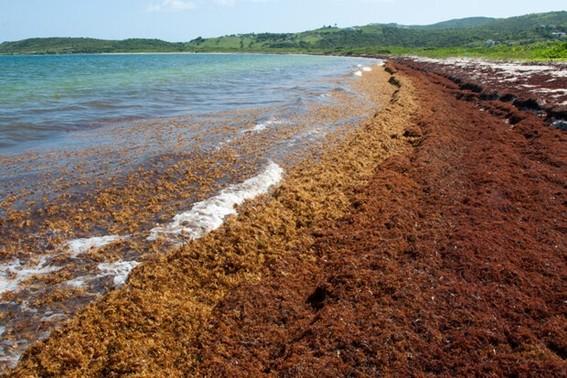
A beach in Saint Martin in the Caribbean covered in Sargassum, November 19, 2011. (Photo by Mark Yokoyama via Flickr. Used under CC BY-NC-ND 2.0 license)
The rise of the Great Atlantic Sargassum Belt
Sargassum is a brown macroalgae that floats freely across the open Atlantic, forming dense mats that can extend for kilometers. In the open ocean, it plays a genuine ecological role: it shelters juvenile fish, sea turtles, crabs, and shrimp, and serves as a nursery habitat for dozens of species. The problem begins when those mats reach shore.
Before 2011, sargassum was largely confined to the Sargasso Sea and the Gulf of Mexico. Then a combination of changes in wind patterns and ocean currents, created conditions that allowed sargassum to spread far beyond its historical range. Researchers now call the result the Great Atlantic Sargassum Belt, a continuous band of floating algae stretching roughly 8,000 kilometers from the coast of West Africa through the central Atlantic to the Caribbean and Gulf of Mexico. The trigger appears to have been an anomalous period in 2009-2010; what sustained it was a steadily more nutrient-rich tropical Atlantic, fed by runoff from the Amazon and Congo rivers and amplified by deforestation and warming waters. Once established, the system proved self-sustaining. Research published in Science in 2019 documented this transformation formally, describing the emergence of a persistent, basin-scale sargassum belt with no historical precedent (Wang et al., 2019).
Every year since 2011, sargassum has expanded in late spring, peaked around summer, and declined in late fall. The trend across that period has been broadly upward, with record years in 2018, 2022, and 2025.
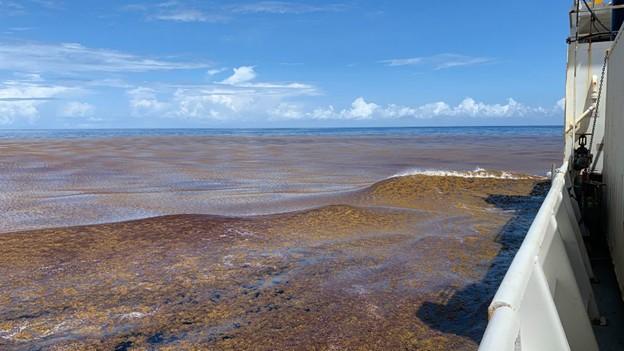
In 2023, WHOI scientists aboard the NOAA ship Ronald H. Brown in the tropical Atlantic took advantage of the ship’s long-planned path through the Great Atlantic Sargassum Belt to take some of the first samples from a massive, ongoing bloom. (Photo by Ellen Park ©Woods Hole Oceanographic Institution)
The 2026 season: earlier, larger, and still growing
The 2026 sargassum season did not wait. In January, NASA satellites detected quantities exceeding any previous January on record, and by March, biomass in the Great Atlantic Sargassum Belt was already 31% above the same period in 2025. Whatever the year ahead holds, it had announced itself early.
The clearest operational picture comes from the University of South Florida's Optical Oceanography Laboratory, which runs the Sargassum Watch System and publishes monthly bulletins tracking the belt's movement across the Atlantic. Their April 2026 report documents what the early signals were pointing to. By mid-April, sargassum had spread across the entire Caribbean Sea, with three distinct large masses visible in satellite imagery. Every monitored region, from the Gulf of Mexico to both sides of the Atlantic, recorded amounts at or near historical highs for April. Total wet biomass reached approximately 28.7 million metric tons in the Atlantic alone, already approaching the full-season record of 38 million metric tons set in July 2025.
The effects are not confined to open water. Major beaching events are already underway across the Caribbean and the Lesser Antilles, with moderate events reaching the southeast coast of Florida. USF's forward guidance projects that beaching will continue and likely intensify in the months ahead, with events possibly extending as far as Louisiana and Texas. By summer, the bulletin suggests, 2026 could surpass every prior year on record.
The cost of arrival
The damage begins before the algae even touches the beach. As sargassum approaches the shore, it releases hydrogen sulfide, a gas with the odor of rotten eggs that causes respiratory irritation and, at high concentrations, poses genuine health risks. In 2018, exposure events in the French Caribbean were documented in peer-reviewed literature, with 154 patients recorded at the University Hospital of Martinique presenting neurological, respiratory, and digestive symptoms (Resiere et al., 2021), and French Caribbean officials temporarily closed schools due to dangerous gas levels during a severe inundation (Resiere et al., 2026). Beyond the gas itself, sargassum absorbs arsenic and other heavy metals during its ocean transit, which accumulate in coastal zones as the mats pile up (Cipolloni et al., 2022; Cipolloni et al., 2024).
In nearshore waters, the consequences follow a different logic. Dense floating mats block sunlight from reaching coral reefs and seagrass beds, suppressing photosynthesis below. When those mats eventually die and sink, they smother the communities living on the seafloor. Decomposition strips the shallow water of dissolved oxygen, triggering fish kills and invertebrate mortality. Sea turtles, which depend on beach access for nesting, face both physical obstruction and broader habitat degradation. Further inland, water intake pipes at desalination plants and industrial facilities can clog entirely, disrupting freshwater supply on islands where desalination is the primary source.
The economic consequences are perhaps the most visible. Tourism suffers first and most sharply: when beaches are buried under decaying algae, visitors cancel, hotels offer refunds, and coastal restaurants see revenues collapse. According to the Inter-American Development Bank, even a moderate bloom cut tourist arrivals in Quintana Roo by 11.6% between 2016 and 2019 (BBVA Research, 2020). Fishing operations face their own disruptions, with fouled nets, blocked access to fishing grounds, and declining catches driven by deteriorating nearshore water quality.
A beach in Saint Martin in the Caribbean covered in Sargassum, November 19, 2011. Photo by Mark Yokoyama via Flickr. Used under CC BY-NC-ND 2.0 license.
A January 2026 study by the Woods Hole Oceanographic Institution and the University of Rhode Island offers the most rigorous quantification to date, examining losses across Puerto Rico, the U.S. Virgin Islands, and Florida's Atlantic coast (Jin et al., 2026). Annual losses are already in the multi-million-dollar range in Puerto Rico and the U.S. Virgin Islands, and could reach billion-dollar scale along Florida's Atlantic coast during severe seasons. Broader estimates from WHOI researcher Di Jin place Florida's total losses, direct and indirect, at around $5 billion in a bad year, with adverse scenarios approaching $10 billion. Miami-Dade County alone spends nearly $4 million annually to remove sargassum from 27 kilometers of public beach, a figure that has grown steadily since systematic removal began in 2019 (WUSF, 2026).
The picture across the wider Caribbean is consistent with these figures. The Caribbean Community (CARICOM), whose 15 member states are home to roughly 44 million people, around 70% of whom live near the coast, recorded losses of approximately $102 million in 2022 alone, itself a record year at the time (Inside Climate News, 2024). The 2026 season is running well above 2022 at every comparable point in the cycle, and the worst months are still ahead.
What is driving this escalation is not a single cause but a set of reinforcing ones: ocean warming, changes in Atlantic circulation, and nutrient enrichment from agricultural runoff and deforestation interact in ways that are not simply additive. A warmer, nutrient-rich ocean with modified circulation is a qualitatively different regime. The practical consequence is that what would have been classified as a moderate sargassum season a decade ago now produces impacts that, in absolute terms, resemble the severe events of that era. The category label may read the same; the consequences do not.
From observable to insurable risk
Sargassum is not typically framed as an insurable risk. That framing is no longer defensible. The damage it causes is real, increasingly well-quantified, and predictable at the seasonal scale. Satellite systems such as USF's Sargassum Watch System and the European Copernicus Marine Service produce reliable near-real-time estimates of sargassum abundance across all major regions, updated continuously throughout the season. Multi-year historical records now exist. Economic impact studies have put numbers on the losses. The conditions that parametric insurance requires are present: a measurable physical index, robust observational infrastructure, documented historical variability, and demonstrated economic exposure. Suyana is actively developing parametric coverage for sargassum-exposed portfolios. The 2026 season, already at or above historical highs across every monitored region with summer still ahead, is not a signal to begin studying the problem. It is a signal to move.
References
BBVA Research. (2020). The risk of sargassum to the economy and tourism of Quintana Roo and Mexico (Working Paper No. 20/02). https://www.bbvaresearch.com/en/publicaciones/the-risk-of-sargassum-to-the-economy-and-tourism-of-quintana-roo-and-mexico/
Cipolloni, O. A., Gigault, J., Dassié, É. P., Baudrimont, M., Gourves, P. Y., Amaral-Zettler, L., & Pascal, P. Y. (2022). Metals and metalloids concentrations in three genotypes of pelagic Sargassum from the Atlantic Ocean Basin-scale. Marine Pollution Bulletin, 178, 113564. https://doi.org/10.1016/j.marpolbul.2022.113564
Cipolloni, O. A., Simon-Bouhet, B., Couture, P., & Pascal, P. Y. (2024). Reduced transfer of metals and metalloids from pelagic Sargassum spp. accumulated in artificial floating barrier. Scientific Reports, 14(1), 27066. https://doi.org/10.1038/s41598-024-76899-5
Inside Climate News. (2024, April 18). After 13 years, no end in sight for Caribbean sargassum invasion. https://insideclimatenews.org/news/18042024/caribbean-sargassum-invasion/
Jin, D., Wang, A., & Dalton, T. (2025). Economic impacts of sargassum events in Puerto Rico, USVI, and coastal Florida. Harmful Algae, 150, 102996. https://doi.org/10.1016/j.hal.2025.102996
Lapointe, B. E., Brewton, R. A., Herren, L. W., Wang, M., Hu, C., McGillicuddy, D. J., Lindell, S., Hernandez, F. J., & Morton, P. L. (2021). Nutrient content and stoichiometry of pelagic Sargassum reflects increasing nitrogen availability in the Atlantic Basin. Nature Communications, 12, 3060. https://doi.org/10.1038/s41467-021-23135-7
NOAA Ocean Service. (n.d.). Sargassum: From sea to shore. National Oceanic and Atmospheric Administration. https://oceanservice.noaa.gov/news/sargassum/
Resiere, D., Mehdaoui, H., Florentin, J., Gueye, P., Lebrun, T., Blateau, A., & Neviere, R. (2021). Sargassum seaweed health menace in the Caribbean: Clinical characteristics of a population exposed to hydrogen sulfide during the 2018 massive stranding. Clinical Toxicology, 59(3), 215–223. https://doi.org/10.1080/15563650.2020.1789162
Resiere, D., Florentin, J., & Névière, R. (2026). Evaluating the ten-year health impact of hydrogen sulfide (H2S) and ammonia (NH3) exposure from sargassum seaweed invasions in the Caribbean: Public health implications. Harmful Algae, 152, 103027. https://doi.org/10.1016/j.hal.2025.103027
Wang, M., Hu, C., Barnes, B., Mitchum, G., Lapointe, B., & Montoya, J. P. (2019). The great Atlantic Sargassum belt. Science, 365(6448), 83–87. https://doi.org/10.1126/science.aaw7912
WUSF Public Media. (2026, May 16). Miami-Dade's sargassum problem isn't going away — and neither are the costs. https://www.wusf.org/environment/2026-05-16/miami-dades-sargassum-problem-isnt-going-away-and-neither-are-the-costs