Is the Super El Niño on its way?
El Niño is likely to develop in the second half of 2026, with NOAA placing its probability above 90% from July onward. Models agree on the direction but diverge on magnitude, leaving real uncertainty about how intense the event will be.

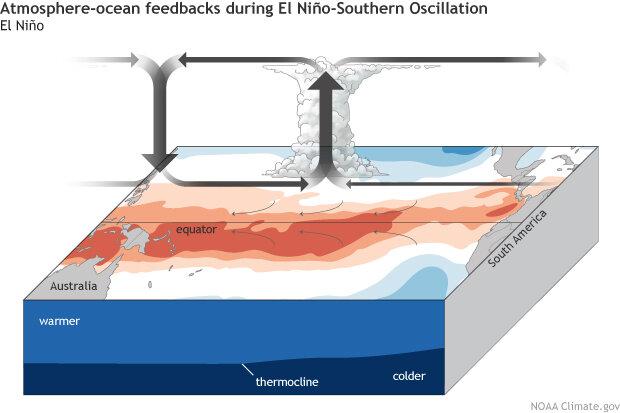
Atmosphere-Ocean feedbacks during El Niño Southern Oscillation.
What El Niño is and what it drives
El Niño and La Niña are the two phases of a climate pattern known as ENSO (El Niño-Southern Oscillation), which oscillates across the tropical Pacific every 3 to 7 years. It is the leading natural driver of interannual climate variability globally: it shifts rainfall patterns, alters the frequency and intensity of extreme events, and leaves a visible imprint on global mean temperature. El Niño years tend to be the warmest of any decade; La Niña years, the coolest (NOAA, 2016).
The mechanism is a feedback loop between the ocean and atmosphere in the equatorial Pacific. Under normal conditions, winds blow from east to west and pile up warm water in the western Pacific. When those winds weaken, warm water migrates toward the centre and east of the basin, shifting where it rains, where droughts occur, and how storm systems organise across much of the world.
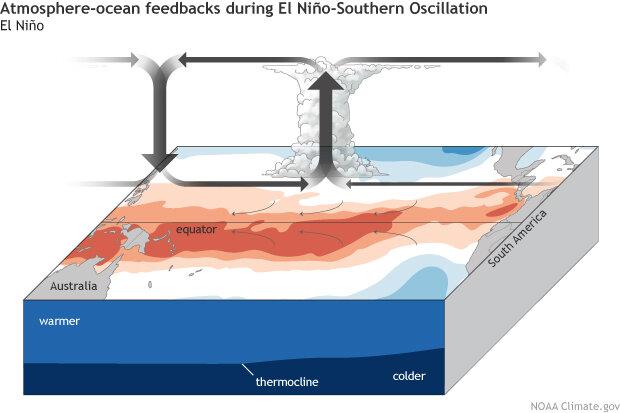
Figure 1. Average (ENSO-neutral) conditions across the tropical Pacific Ocean, showing the typical configuration of trade winds, sea surface temperatures and atmospheric circulation (Climate.gov schematic by Emily Eng, inspired by NOAA PMEL).
Impacts vary strongly by region and are not symmetric across phases. El Niño tends to suppress Atlantic hurricane activity, reducing exposure in the Caribbean and Gulf of Mexico, but raises the risk of drought across northeastern South America and parts of sub-Saharan Africa. La Niña works in the opposite direction: more Atlantic hurricanes, heavier rainfall in Indonesia and Australia, and greater water deficits in the Southern Cone. It is worth keeping in mind that these are general tendencies, not certainties. Every El Niño event plays out differently, and regional impacts can be amplified, dampened or overridden by other climate drivers.
What makes an ENSO 'Super'?
There is no formal definition. "Super El Niño" is shorthand used in the literature and the press for the strongest events on record, those where Niño-3.4 anomalies sit at or above +2.0 °C during peak winter. NOAA classifies these as "very strong," and only three events since 1950 have crossed that line: 1982-83, 1997-98, and 2015-16.
The threshold matters because impacts do not scale linearly. A moderate El Niño shifts rainfall patterns, a Super El Niño rewrites them. The 1997-98 event triggered catastrophic flooding along the coasts of Peru and Ecuador, severe drought across Indonesia and northeastern Brazil, and an estimated USD 35-45 billion in global economic losses. The 2015-16 event produced one of the most severe droughts on record in the Amazon, drove food security crises across the Horn of Africa, and caused the third global coral bleaching event in recorded history. Each of the three pushed global mean temperature to a new record at the time.
One feature of the 2026/27 setup has no historical analogue. Ocean heat content is at record levels independent of ENSO, which means a moderate El Niño on top of an already warm baseline can produce impacts that resemble a stronger event of decades past. Heatwaves compound on an already elevated background, and atmospheric moisture is higher, intensifying rainfall extremes. The category label may read "moderate," but the consequences may not. This is why the upcoming forecast cycle is worth watching closely. The difference between a +1.5 °C peak and a +2.5 °C peak is not just a number on a model plume; it is the difference between a manageable event and a regional crisis.
How ENSO is forecast and how much to trust it
There are two types of models used to forecast ENSO. Statistical models identify historical patterns and extrapolate them. They are fast and cheap, but do not incorporate information about the current subsurface ocean state. On the other side, dynamic models can simulate the physics of the ocean-atmosphere system from updated observations, including satellite sensors and subsurface buoys placed in the central Pacific Ocean. They are more computationally expensive but capture signals that statistical models miss.
For most of the year, both families perform similarly. The exception is boreal spring, when dynamic models clearly outperform statistical ones. In that window, dynamic models explain around a third of subsequent ENSO variability; statistical models barely register a signal. That gap has direct consequences for how to read current forecasts (Ehsan et al., 2024).
Every year, between March and May, forecast skill drops to its annual low in what is known as the spring predictability barrier. This is not a model failure but a property of the physical system: ocean-atmosphere coupling weakens during this period, so models can detect anomalies in the ocean but cannot predict whether the atmosphere will respond to them. The result is high uncertainty even at short lead times (L'Heureux, 2015).
From June onward the picture improves. The temperature contrast recovers, ocean-atmosphere coupling strengthens, and if a Niño is developing, the physical signals become consistent and readable. Models initialised in August already explain close to 75% of boreal winter ENSO variability, rising to around 90% for models initialised in October.
At this moment of the year, we are currently in the middle of the barrier. The European Centre for Medium-Range Weather Forecasts (ECMWF) indicates that the window of greater clarity will open between May and June. If by then the trade winds weaken coherently and convection shifts toward the central Pacific, forecast confidence will rise significantly. If that response does not appear, the range of scenarios will remain wide.
2026 forecast: strong signal, real uncertainty
The official CPC/NOAA forecast of April 9 puts El Niño at 61% probability for May–July, rising steadily to above 90% from July onward and staying there through the end of the year (Figure 2). The CPC also flags a 1-in-4 chance (25%) of a Super El Niño, defined as Niño-3.4 anomalies at or above +2.0 °C, during the upcoming northern hemisphere winter.
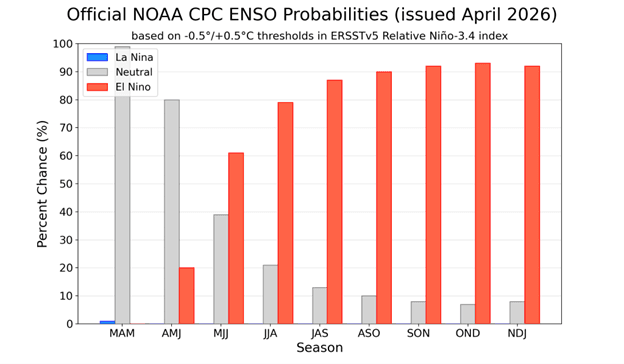
Figure 2. Official NOAA CPC probabilistic ENSO forecast issued April 2026. Bars show the percentage chance of La Niña (blue), ENSO-neutral (grey), and El Niño (red) conditions for each overlapping three-month season from MAM 2026 through NDJ 2026/27. Probabilities are based on the ERSSTv5 Relative Niño-3.4 index with ±0.5 °C thresholds. Source: NOAA Climate Prediction Center, April 9, 2026.
But probabilities alone do not tell us how strong the event might be. To get a sense of the intensity, we look at what individual models are actually projecting. The International Research Institute for Climate and Society (IRI) consolidates forecasts from 26 models worldwide into a single plume, where each line represents one model's projection of sea surface temperature anomalies in the Niño-3.4 region (Figure 3). The dynamical model average points to around +1.7 °C by mid-year and +2.1 °C by year-end, while statistical models are more conservative, peaking near +1.3 °C. Some models project a very strong event, with the most aggressive reaching +3.5 °C, while others forecast a modest warming that stays below +1 °C throughout. That spread reflects the genuine uncertainty that remains at this stage of the forecast cycle.
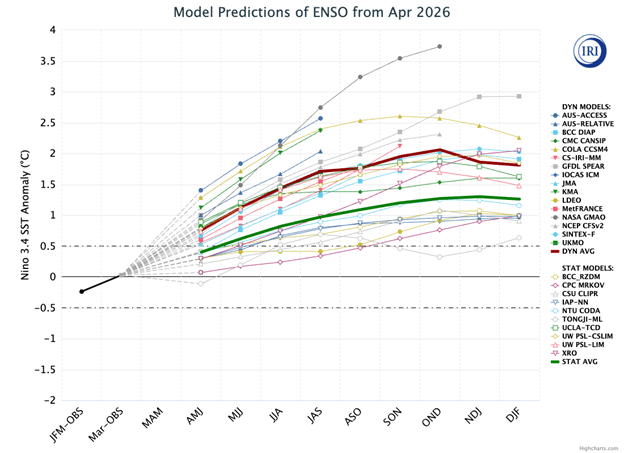
Figure 3. IRI multi-model ENSO plume initialised in April 2026. Each line represents a single model's forecast of Niño-3.4 SST anomaly (°C) through DJF 2026/27. Dynamical models are shown in colour with filled markers; statistical models in grey with open markers. Bold lines indicate the dynamical (dark red) and statistical (dark green) multi-model means. The dashed horizontal lines mark the El Niño (+0.5 °C) and La Niña (−0.5 °C) thresholds. Source: IRI/CPC ENSO Predictions Plume, April 2026.
In Summary
To summarise where the main modelling centres stand for September, Table 1 shows the projected Niño-3.4 anomaly ranges. The spread across institutions reflects the same uncertainty visible in the plume: a moderate event is the central scenario, but a strong one cannot be ruled out.
| Model system | Range |
|---|---|
| ECMWF SEAS5 | +1.7 to +3.3 °C |
| Met Office | +1.5 to +2.8 °C |
| C3S multi-model | +0.2 to +3.3 °C |
Table 1. Niño-3.4 anomaly range for September 2026
Climate change adds a further layer of complexity. Ocean background temperatures are at record levels, which does not necessarily produce a more intense El Niño in relative terms, but does amplify associated impacts. Heat extremes compound an already elevated baseline, and heavy rainfall events are enhanced by greater atmospheric moisture. El Niño-linked events in 2026 may therefore behave differently from what historical records would suggest. What the models agree on is the direction. What they disagree on is the magnitude. That is where things stand as of April 2026.
What this means for Suyana
El Niño's footprint on South American agriculture is well documented and, for the sector, consequential. In Argentina, for example, El Niño years are associated with above-average precipitation across the Pampas and the littoral provinces, which raises flood and waterlogging risk for soy, corn and wheat during critical growth stages. Higher soil humidity is welcome, but excess rainfall at harvest can translate directly into quality losses and logistics disruptions.
In the Andean foothills and parts of Bolivia and Peru, El Niño typically brings drought conditions during the austral summer, hitting rainfed agriculture and water availability for irrigation-dependent crops. The asymmetry matters: the same event that floods the Pampas can dry out the altiplano.
These are precisely the kinds of spatially variable, probabilistic climate risks that parametric insurance is designed to address. At Suyana, we are actively monitoring ENSO development as a key input to our trigger design and exposure assessments for the 2026/27 agricultural season.
What we are watching
ENSO forecasts are updated monthly and the picture will sharpen considerably from June onward. If you want to follow the signal yourself, these are the sources we rely on:
NOAA Climate Prediction Center publishes a monthly ENSO Diagnostic Discussion, including official probability forecasts and the IRfI/CPC model plume. It is the authoritative operational reference.
ECMWF Seasonal Forecasts offer the most detailed dynamical modelling available publicly, with the SEAS5 ensemble updated monthly. The ECMWF science blog also provides expert interpretation of the forecasts in plain language.
IRI ENSO Forecasts consolidate the full multi-model plume in one place, with both dynamical and statistical models, updated monthly. The IRI also maintains an archive of past forecasts that is useful for understanding model behaviour over time.
The next key update to watch is the May diagnostic discussion, expected around May 14. By then we will be past the deepest point of the spring predictability barrier.
We will publish updated forecasts after the May discussion. Stay tuned!
References
Barnston, A. G., Tippett, M. K., L'Heureux, M. L., Li, S., & DeWitt, D. G. (2012). Skill of real-time seasonal ENSO model predictions during 2002-11: Is our capability increasing? Bulletin of the American Meteorological Society, 93(5), 631-651. https://doi.org/10.1175/BAMS-D-11-00111.1
Ehsan, M. A., L'Heureux, M. L., Tippett, M. K., Robertson, A. W., & Turmelle, J. (2024). Real-time ENSO forecast skill evaluated over the last two decades, with focus on the onset of ENSO events. Climate and Atmospheric Science, 7, 301. https://doi.org/10.1038/s41612-024-00845-5
L'Heureux, M. (2015). The Spring Predictability Barrier: we'd rather be on Spring Break. NOAA Climate.gov ENSO Blog. https://www.climate.gov/news-features/blogs/enso/spring-predictability-barrier-we%E2%80%99d-rather-be-spring-break
NOAA Climate Prediction Center. (2026, April 9). ENSO Diagnostic Discussion. https://www.cpc.ncep.noaa.gov/products/analysis_monitoring/enso_advisory/ensodisc.shtml
NOAA Climate.gov. (2016). El Niño and La Niña: Frequently asked questions. https://www.climate.gov/news-features/understanding-climate/el-nino-and-la-nina-frequently-asked-questions
Stockdale, T. (2026, April 10). How confident should we be in a prediction of El Niño? ECMWF Science Blog. https://www.ecmwf.int/en/about/media-centre/science-blog/2026/el-nino-2026