Why Climate Insurance Is Hard to Get Right
Parametric insurance pays farmers automatically when drought hits, but only if the index reflects real losses.

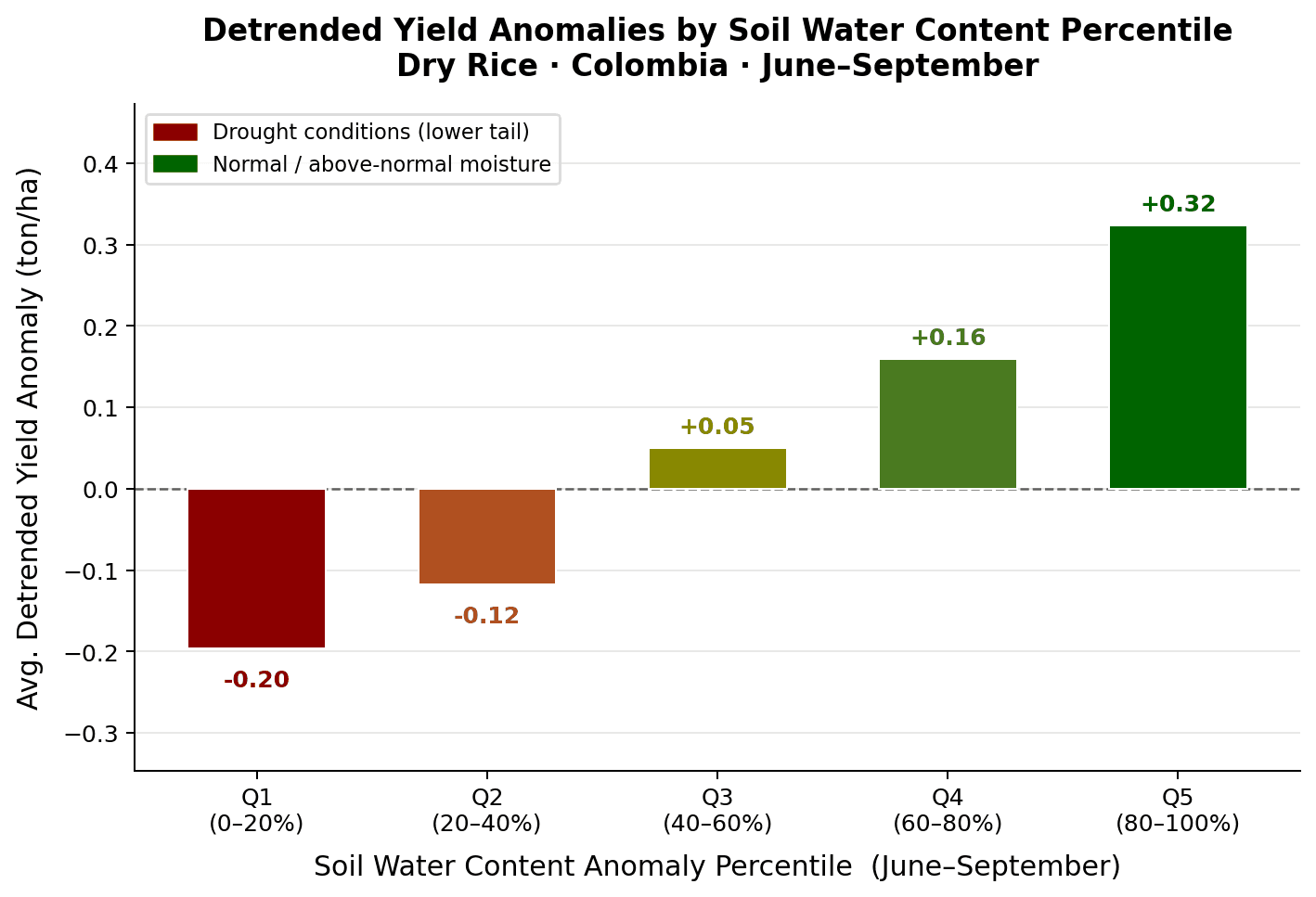
Satellite-based soil moisture drought index for rice farming in Colombia.
Parametric Design: Strengths and Challenges
Drought is one of the most damaging risks for agricultural producers in Latin America. It arrives gradually, it is hard to measure at the farm level, and by the time its effects are visible in yields, the damage is already done. Traditional crop insurance tries to address this, but it relies on field inspections and loss adjusters. That process is slow, expensive, and logistically impossible to scale across thousands of small farms spread across remote municipalities. In practice, most smallholder farmers in Latin America have no access to any form of crop insurance at all.
Parametric insurance offers a different path. Instead of measuring losses directly, it pays out when a predefined climate index crosses a threshold. The payment is fast, transparent, rule-based, and requires no inspection. But this approach comes with a fundamental challenge: the index has to actually reflect what happens to yields. If it does not, farmers pay premiums for a product that does not protect them when they need it most. That gap between what the index measures and what the farmer loses is called basis risk, and it is the central technical problem in parametric insurance design.
At Suyana, we take that problem seriously. We build our indices from satellite data, which gives us continuous, spatially consistent measurements of soil conditions across entire regions. But choosing the right variable, the right time window, and the right way to aggregate that signal into a trigger requires careful validation against real yield outcomes. A plausible index is not enough. We need evidence that it tracks losses.
Index Selection: Our Experience in Colombia
We design parametric drought insurance alongside the producers themselves. In Colombia, for example, we worked directly with rice farmers in the Orinoquía region to design an index based on soil moisture observations for rainfed rice. Their input was crucial to identify critical time windows in the crop cycle. Our index tracks soil water deficits using satellite data, targeting the growth stages where drought damage is greatest.
We validated our approach using municipal yield records published by UPRA, Colombia's agricultural planning unit. The results are clear: when our index signals drought conditions, yields fall; when it signals normal or above-normal soil moisture, yields recover. This relationship holds consistently across municipalities and years.
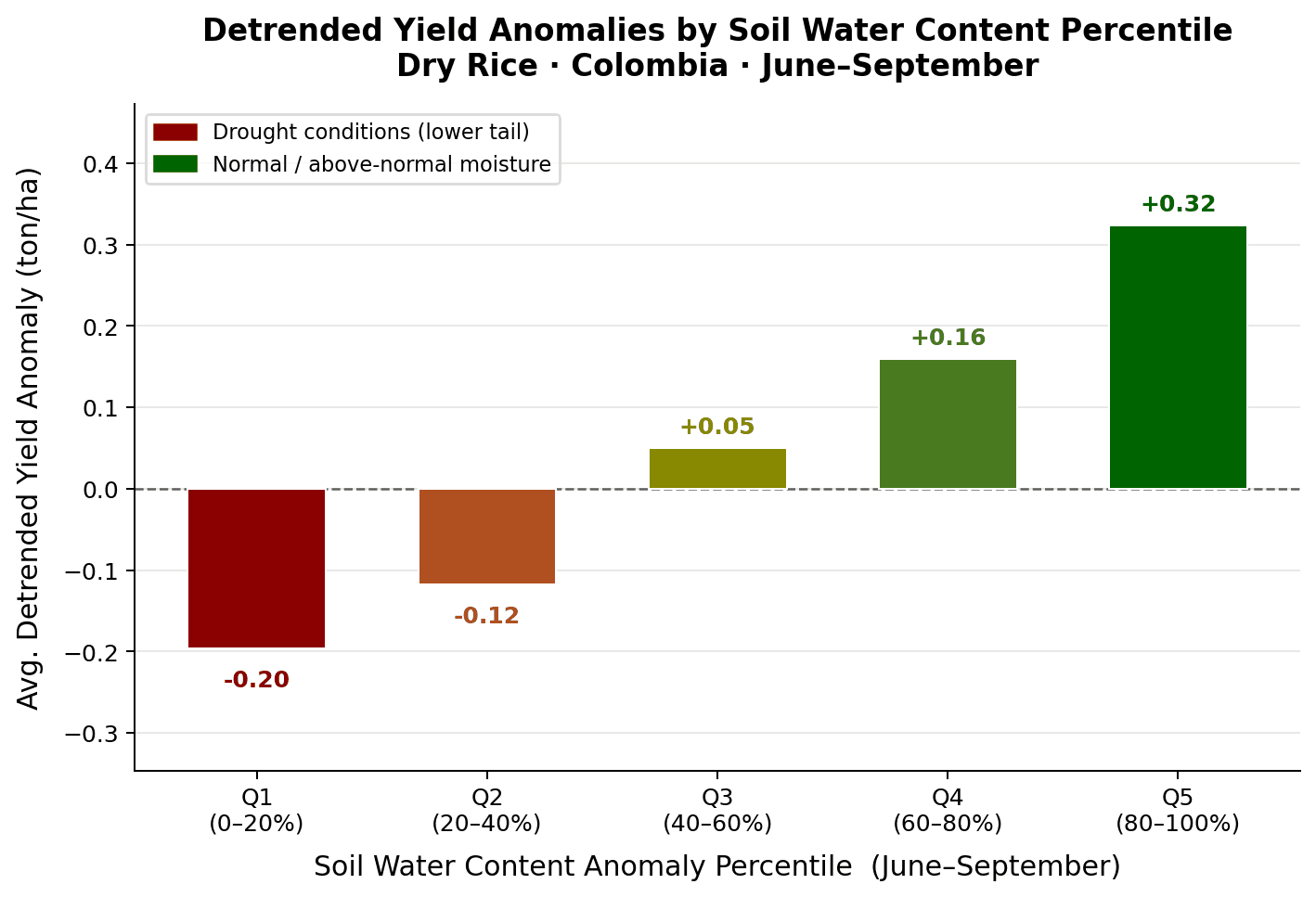
Satellite-based soil moisture drought index for rainfed rice in Colombia’s Orinoquía region, focused on the crop’s most critical growth windows.
Municipalities where our index recorded the driest conditions experienced below-average yields. Those with adequate moisture had above-average yields. The pattern is gradual and ordered, not driven by isolated extremes.
This is what matters to us at Suyana: an index that reflects what farmers actually experience, and a product that pays at the right moment based on conditions shown to cause real losses: fast, transparent, and grounded in data.
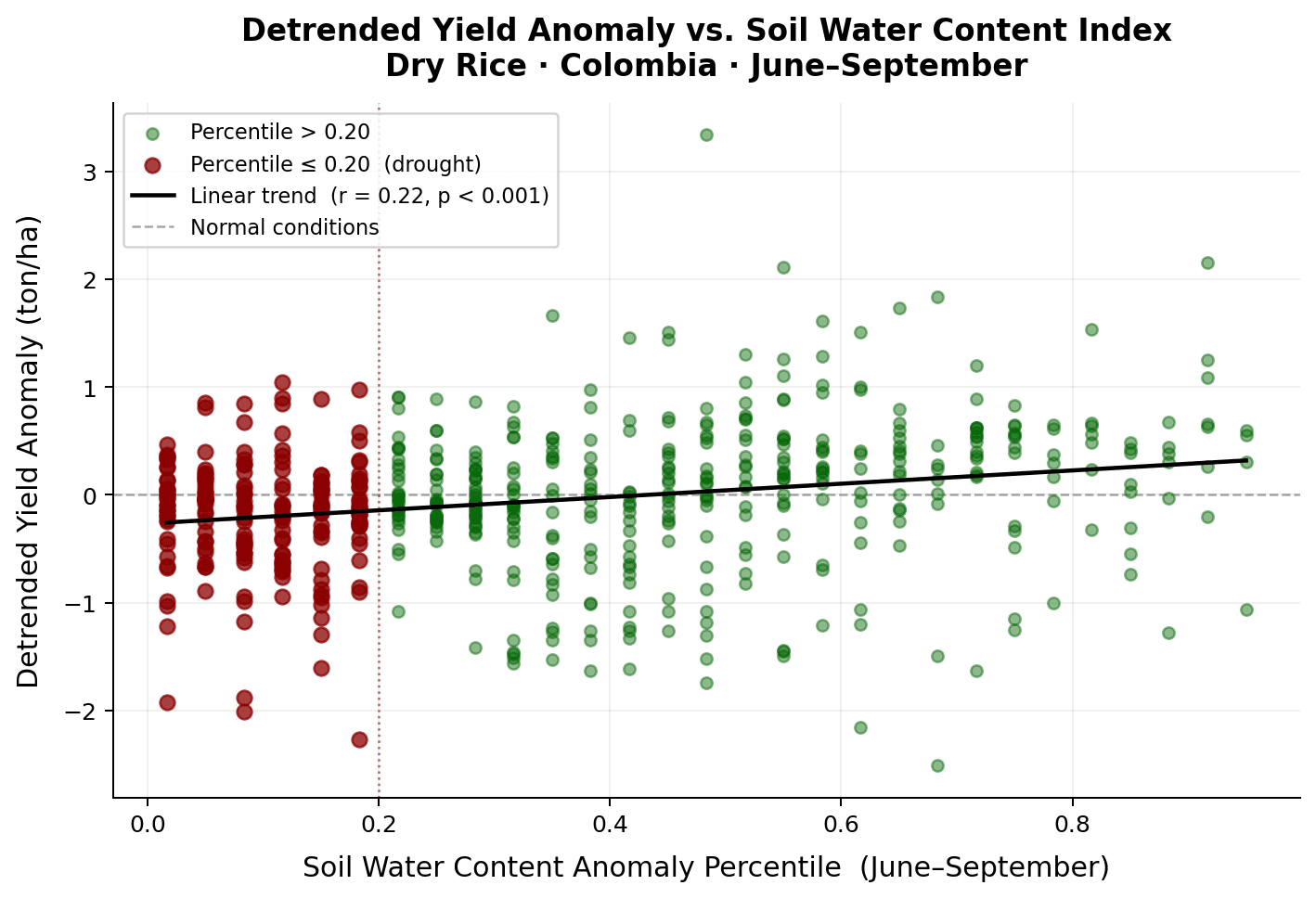
Index validation: drier conditions flagged by the index align with lower yields, showing a consistent pattern across municipalities and years.
What Comes Next
Getting the index right is only the first step. A well-designed parametric product also needs pricing that reflects actual risk, distribution channels that reach smallholders, and trust from the farming communities it serves. We are working on all of these, and the foundation is always the same: validated, transparent science that farmers and insurers can rely on.